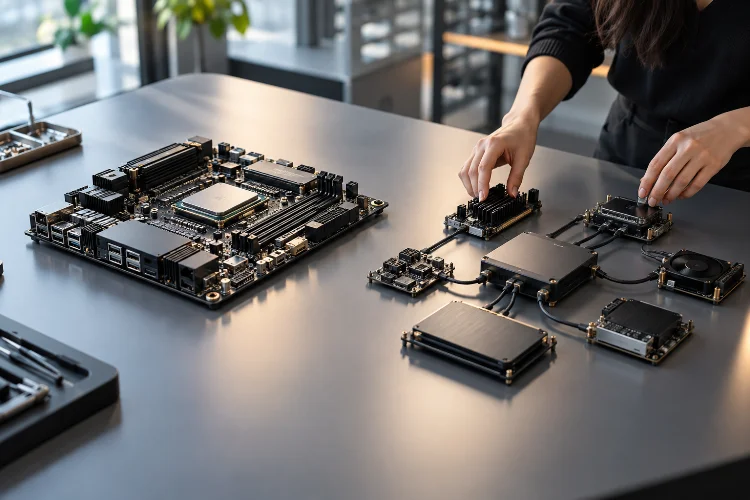
Modern laptops, smartphones, servers, and even small embedded devices rarely depend on a single CPU core anymore. A typical device may contain several processing cores, and some chips combine high-performance cores with smaller efficiency-focused cores.
That sounds simple: more cores should mean more performance. In reality, giving an operating system eight or sixteen cores creates a complicated coordination problem.
The OS has to decide which task runs where, how memory is shared, when work should move between cores, and how to stop several processors from changing the same data at the same time.
That is why modern operating system architecture for multi-core devices is built around concurrency rather than simply faster execution.
The kernel must keep the system responsive while balancing performance, security, power consumption, and hardware differences.
Understanding this architecure gives you a much clearer picture of what actually happens underneath Android phones, Linux servers, Windows PCs, and other modern computing platforms.
How Multi-Core Hardware Changes Operating System Design
Traditional explanations of operating systems often describe a CPU executing one instruction stream while the OS switches rapidly between applications. Multi-core hardware changes that model because several instruction streams can genuinely execute at the same time.
If a processor contains eight logical CPUs, for example, the kernel may have eight different threads running simultaneously. One core could be processing a browser tab while another handles networking, another runs background services, and another performs graphics-related work.
This creates true parallelism, but it also introduces shared-resource problems.
Multiple cores may need access to the same memory, filesystem structures, device drivers, or kernel data. The operating system therefore needs mechanisms that let processors cooperate without constantly blocking one another.
A modern kernel is consequently designed around scalable data structures, per-CPU state, asynchronous work, fine-grained locking, and sophisticated scheduling.
CPU Scheduling Is the Heart of Multi-Core Performance
The scheduler decides which runnable thread receives processor time. On a multi-core device, however, it must also decide which core should execute that thread.
Per-Core Work and Load Balancing
Modern schedulers commonly maintain scheduling information associated with individual CPUs rather than placing every task into one enormous global queue.
This reduces contention. If every processor repeatedly needed to lock the same global scheduling structure, adding more CPU cores could actually create additional overhead.
The scheduler also performs load balancing. Imagine an eight-core processor where one core has six runnable tasks while four other cores are almost idle. The operating system can migrate some work so processing capacity is used more effectively.
Linux provides a particularly useful example. Its scheduler infrastructure supports multiprocessing, scheduler domains, capacity-aware scheduling, and other mechanisms designed to distribute work across CPUs.
Current Linux documentation also describes the transition toward the Earliest Eligible Virtual Deadline First, or EEVDF, scheduling model for normal tasks.
The goal is not simply to keep every CPU busy. Excessive task migration can hurt performance because the thread may lose useful cache data when it moves to another core.
Heterogeneous Cores Make Scheduling Even Smarter
Not every core in a modern processor necessarily has the same performance capability.
Many mobile and increasingly desktop-oriented processors use heterogeneous designs. Some cores are optimized for maximum performance, while others emphasize lower power consumption.
That means the scheduler may need to consider both task demand and CPU capacity.
A heavy video-encoding thread might benefit from a powerful core, while a lightweight background synchronization job could run perfectly well on an efficiency core.
Linux capacity-aware scheduling, for example, allows scheduling decisions to account for differences in CPU computational capacity.
This creates a more effecient system because performance becomes a placement problem rather than simply a question of whether a processor is idle.
Schedulers may therefore consider task utilization, processor capacity, cache topology, energy use, affinity, priority, and latency requirements before making a decision.
Memory Management Has to Work Across Many Cores
CPU scheduling is only one part of modern operating system design. Every running process also depends heavily on memory management.
Operating systems create virtual address spaces that isolate applications from one another. The kernel manages page tables, memory allocation, demand paging, shared mappings, caches, and many other resources.
Linux documentation, for instance, describes virtual memory, demand paging, kernel allocation, userspace memory, and file mappings as major responsibilities of its memory-management subsystem.
Multi-core hardware makes this harder because several processors can access shared memory concurrently.
NUMA Adds Another Layer
Large multi-core servers often use Non-Uniform Memory Access, or NUMA.
With NUMA, memory access time can depend on where memory physically resides relative to a processor. A CPU may access memory attached to its local NUMA node faster than memory associated with another node.
An operating system therefore benefits from keeping computation close to the memory it frequently uses.
Linux exposes NUMA-aware memory policies and manages memory resources across individual nodes.
This is a good example of why modern OS performance cannot be explained by CPU frequency alone. Where a thread runs and where its memory lives can both influence application performance.
Synchronization Prevents Multi-Core Chaos
Suppose two CPU cores attempt to update the same kernel structure simultaneously.
Without coordination, one processor could overwrite changes made by another, producing corrupted data or unpredictable behavior. These situations are called race conditions.
Operating systems therefore rely on syncronization mechanisms such as mutexes, spinlocks, semaphores, atomic operations, read-write locks, and memory barriers.
Linux kernel documentation separates locking mechanisms into categories including sleeping locks, CPU-local locks, and spinning locks.
A spinlock, for example, may be useful when one processor needs exclusive access to a tiny critical section for a very short period. Instead of sleeping, the waiting processor repeatedly checks until the lock becomes available.
Locking everything would technically prevent many races, but it would also destroy scalability.
Modern kernel developers therefore try to minimize shared state, shorten critical sections, use per-CPU data when possible, and choose locking mechanisms appropriate to each situation. The challenge is balancing correctness against concurrency.
Interrupts and Inter-Core Communication Keep Hardware Connected
Operating systems constantly receive events from hardware.
A network adapter might signal that a packet has arrived. Storage hardware may report that an operation has completed. A timer can trigger scheduling activity.
These signals are commonly handled through interrupts.
On multi-core systems, interrupts can often be distributed between CPUs instead of being handled by one processor. This reduces bottlenecks and can improve throughput.
Processors also need ways to signal one another. Inter-processor interrupts can trigger actions on another CPU, such as scheduling-related work or system coordination.
The important point is that modern kernel communcation is highly parallel. Hardware events, software threads, background workers, device drivers, and processor cores are interacting continuously.
Designing these pathways carefully is essential because interrupt overhead or poor CPU placement can reduce responsivness even when plenty of raw processing power is available.
The Kernel Connects Applications to Complex Hardware
Most applications do not directly control CPU cores, physical memory, storage controllers, or network devices. They interact with higher-level operating system services.
This layered architecture keeps software manageable.
Android provides a clear real-world example. Its architecture includes applications and framework APIs above system services, the Android Runtime, native libraries and daemons, hardware abstraction layers, and the Linux-based kernel underneath.
The Hardware Abstraction Layer helps separate higher-level Android functionality from vendor-specific hardware implementations.
Modern Android kernels also use the Generic Kernel Image approach to create stronger separation between generic kernel components and hardware-specific vendor modules.
This type of modularity matters because an operating system may need to support hundreds or thousands of hardware combinations while maintaining a reasonably consistent software interface.
Scalability Matters More Than Simply Adding Cores
One of the biggest misconceptions about multi-core computing is that twice as many cores automatically provide twice the performance.
They usually do not.
Some workloads cannot be divided efficiently. Others spend time waiting for memory, storage, network activity, or synchronization. Threads may also compete for shared caches and memory bandwidth.
Operating system scalability therefore depends on reducing contention as processor counts rise.
Windows illustrates another dimension of this challenge. Microsoft uses processor groups to organize machines with very large numbers of logical processors.
On current Windows versions, processes can span processors across multiple groups by default on systems containing more than 64 logical processors.
FreeBSD’s SMP architecture similarly includes mechanisms such as CPU binding and thread pinning when work needs to remain on a particular processor.
These mechanisms show how operating systems evolve as hardware moves from a few cores toward dozens or hundreds of execution contexts.
Power Management Is Now Part of Performance Management
Mobile devices make one architectural trade-off particularly obvious: maximum CPU performance is not always desirable.
Running every core at maximum frequency would increase heat and drain batteries quickly.
Modern operating systems coordinate processor frequency, idle states, task placement, and workload demand. When processing demand falls, some cores can enter deeper idle states. When performance is required, frequencies or active-core counts can increase.
This relationship between scheduling and energy management is especially important in phones, tablets, ultrathin laptops, and heterogeneous processors.
The best operating system is therefore not the one that keeps every core busy.
It is the one that delivers the required performance while using CPU time, memory bandwidth, thermal headroom, and electrical power intelligently.
Modern operating system architecture for multi-core devices is fundamentally about coordination.
The kernel must distribute work between processors, keep memory close to computation, synchronize shared resources, process interrupts, manage hardware interfaces, and control energy consumption without making applications unnecessarily complex.
As core counts increase and heterogeneous processors become more common, these responsibilities become even more important.
For developers, students, and technology professionals, learning how scheduling, memory management, synchronization, NUMA, and hardware abstraction work provides a strong foundation for understanding modern computing.
If you want to go deeper, start exploring real kernel scheduler and memory-management documentation. Seeing how Linux, Android, Windows, and FreeBSD approach these problems turns abstract operating-system concepts into practical engineering decisions.